Movies Haven’t Lost Their Magic — But the Way We Discover Them Has Changed Forever
Movies have never been easier to find, watch or talk about. Yet in an age of streaming algorithms, instant trailer drops, TikTok clips and endless recommendations, actually discovering a film can feel harder than ever. The movies haven't lost their magic. What has changed is how they find us.
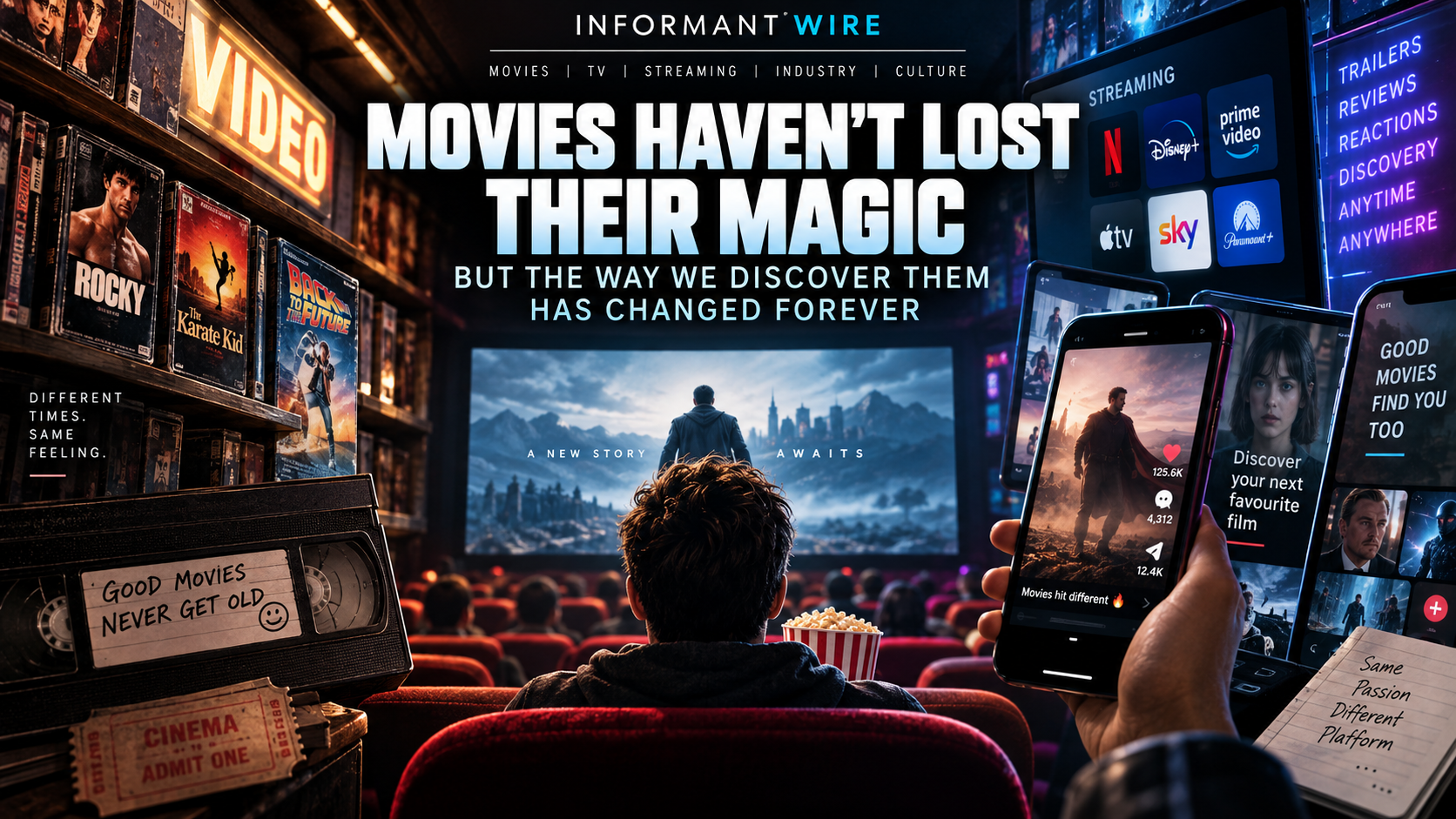
Movies have never been more accessible. Thousands of films are only a few taps away, trailers can reach millions within hours, and social media can turn a forgotten title into the film everyone is suddenly talking about.
Yet with streaming platforms, recommendation algorithms, endless scrolling and more entertainment competing for our attention than ever before, discovering something that genuinely feels special has arguably become more complicated.
Cinema hasn't lost the ability to surprise us, move us or create moments we'll remember for decades. What has changed is the journey that brings a movie into our lives — from cinema queues and video-shop shelves to algorithms, smartphones and a screen that never stops recommending what to watch next.
There Have Never Been More Movies Fighting for Your Time
The entertainment industry has spent years worrying about how to get audiences' attention.
The strange part is that audiences have never had more movies competing for it.
Open a streaming service, and hundreds of titles are waiting. Open another, and hundreds more are waiting. Scroll through social media and within minutes you might see a trailer, a film clip, an actor interview, a fan edit, a review and somebody explaining the ending of a movie you haven't even watched yet.
The problem in 2026 isn't access.
It's attention.
That distinction is becoming increasingly important. Recent audience research in Australia, for example, found a strong appetite for local screen content, but only 36% of respondents thought it was easy to find. The report highlighted algorithms, recommendations, social media and peers as increasingly important routes through which audiences discover what to watch.
That's one market, not the entire global audience, but it illustrates a much bigger problem facing modern entertainment.
When everything is available, how does anything feel like a discovery?
Movies Used to Have to Find You
Forty years ago, discovering a movie was a completely different experience.
There was no homepage to learn what you liked.
No push notification announcing that a trailer had arrived.
No endless scroll.
A movie might enter your life because you saw its poster outside a cinema. Maybe a trailer appeared before another film. Perhaps somebody at school told you about it. You might have discovered it through a magazine, television advert or simply because its VHS cover looked incredible on the shelf of the local video shop.
That scarcity could make individual discoveries feel enormous.
Think about 1986.
Top Gun. Aliens. Ferris Bueller's Day Off. Stand by Me. The Fly. Highlander. Labyrinth.
Those movies weren't competing with a personalised library you could access instantly from a device in your pocket.
They had to earn space in popular culture through cinemas, television, print, word of mouth and eventually home video.
Our sister publication Movies in the 80s recently revisited 1986 and the remarkable collection of films that made it one of the decade's defining movie years.
Forty years later, the films remain.
The machinery that introduces audiences to them has transformed.
Hollywood Still Wants You to Feel Like You Have to Be There
One thing hasn't changed.
Hollywood still wants an opening weekend to feel important.
Perhaps it needs that feeling more than ever.
The modern campaign doesn't simply sell a movie. It tries to manufacture a moment: premieres, social clips, branded experiences, fan events, cast appearances, memes and online conversations all building towards the same weekend.
Recent campaigns demonstrate just how far that can go. Lionsgate's 2026 marketing for Michael, for example, incorporated social media, live promotional experiences and nostalgia aimed at different generations, with the studio explicitly describing the importance of making campaigns feel like events.
The technology is new.
The objective isn't.
For decades, studios have been trying to create the feeling that one particular movie is the movie everybody will be talking about on Monday morning.
The Blockbuster Was Already Becoming a Global Conversation
By 1996, Hollywood had become exceptionally good at creating events.
Independence Day didn't quietly arrive.
Neither did Twister.
Mission: Impossible launched a franchise that would span decades, while Scream understood the rules of horror cinema and then turned them inside out.
But something else was happening.
The internet was entering ordinary homes.
Slowly.
Noisily.
Usually after making that dial-up sound nobody who lived through it will ever forget.
Cinema culture hadn't moved online yet, but the foundations were being laid for what would eventually become an enormous transformation.
Movies in the 90s looked back at 1996 and the films that defined the middle of a decade caught between traditional Hollywood and the approaching digital world.
Audiences were still buying tickets, reading magazines and visiting video shops.
But another door had opened.
Two Minutes of Footage Can Become Worldwide News
Today, a major trailer can become entertainment news within seconds.
The studio uploads it.
Notifications fire.
Entertainment publications publish stories.
Reaction videos appear.
Screenshots hit social media.
Fans start analysing individual frames.
Within hours, scenes nobody had seen that morning can be watched, paused, enlarged, debated, and turned into memes around the world.
That is an extraordinary change when you consider how trailers were once consumed.
There was a time when you might only see a trailer because you happened to be sitting in the right cinema or because it appeared before a VHS you'd rented.
The Movie Trailer recently explored how trailers went from cinema previews, television spots and painfully slow downloads to instant global online events.
The trailer hasn't disappeared.
If anything, it has become more powerful.
What disappeared was the waiting.
Your Next Favourite Movie Might Already Be Looking for You
Streaming changed another fundamental part of movie discovery.
The shelf disappeared.
In its place came the recommendation engine.
Watch one film, and another appears underneath it.
Finish a thriller, and suddenly the service has an entire row of thrillers waiting.
Pause over a title and a preview might begin playing before you've even decided whether you're interested.
This can be incredibly useful.
It can also make entertainment feel strangely disposable.
A physical video shop had limitations. Only so many films could fit on its shelves. But those limitations meant you could understand the space.
Streaming offers something closer to infinity.
The challenge isn't finding something to watch.
It's deciding which of the thousands of available somethings deserves the next two hours of your life.
The Moment the Old and New Worlds Collided
If 1986 belonged to cinemas, television and video shops, and 1996 represented the first signs of the internet age, 2006 feels remarkably close to the dividing line.
YouTube had arrived the previous year.
Broadband was spreading.
Online video was becoming practical.
Movie websites were established.
Forums and early social platforms allowed fans to gather around releases in ways that would have been impossible a decade earlier.
Yet physical media was still enormous.
DVD collections filled shelves.
People still walked into shops and bought films.
Cinema remained central to major releases.
And the films were pretty good too.
Casino Royale. The Departed. The Prestige. Children of Men. Pan's Labyrinth. The Devil Wears Prada. Little Miss Sunshine. Rocky Balboa.
Movies in the 00s recently revisited 2006 and the films that arrived as cinema crossed deeper into the digital era.
Twenty years later, that transition is complete.
The internet isn't part of movie culture.
Movie culture lives inside the internet.
A Film Doesn't Always Need a Studio Campaign Anymore
Perhaps the biggest change is that studios no longer completely control discovery.
Audiences do some of it themselves.
A scene resurfaces.
An actor suddenly trends.
Somebody posts a clip.
A creator recommends an overlooked movie.
Thousands of people start talking about a film that may have been released years earlier.
That creates a fascinating second life for movies.
The old release calendar told audiences when something mattered.
Modern culture can decide that a movie matters again whenever it wants.
Yesterday's forgotten title can become tomorrow's obsession.
The video-shop employee recommending something obscure has effectively been replaced by millions of people recommending things to each other simultaneously.
The scale changed.
The instinct didn't.
Hollywood Is Still Trying to Work Out How Much Nostalgia Is Too Much
Another contradiction sits at the centre of modern Hollywood.
Familiarity is incredibly valuable.
So is novelty.
Studios want audiences to recognise something, but they don't necessarily want it to feel recycled.
That tension is visible even in the language used to market films. In 2026, industry executives have discussed avoiding terms such as “reboot” and “remake” when they believe those labels make audiences think they're being sold something they've already seen. At the same time, established brands continue to provide valuable awareness.
It's a difficult balance.
Give audiences something familiar.
But make it feel like a discovery.
That might explain why nostalgia has become such a powerful ingredient in contemporary entertainment.
Please Rewind recently looked across 1986, 1996 and 2006 to examine how three movie years came to define three different generations.
Modern entertainment doesn't simply leave those generations behind.
It continually talks to them.
The Screen Isn't the Only Thing That Matters — The Experience Does Too
For years the conversation has been framed as a battle.
Cinema versus streaming.
But audiences don't necessarily live inside such neat categories.
They can watch a series on a phone Tuesday night, stream a movie on television Friday and sit inside an IMAX auditorium Saturday.
The more interesting question is what makes them choose one experience over another.
That debate is very much alive in 2026. Different companies continue to take markedly different approaches to theatrical distribution, while filmmakers, studios and streaming platforms debate which movies need cinemas and which don't.
Cinema therefore has to offer something a living room can't.
Scale.
Sound.
Community.
And perhaps most importantly, occasion.
When hundreds of strangers react at the same moment, entertainment becomes communal again.
No algorithm can completely reproduce that.
Spectacle Alone Isn't Enough
Modern movies can do what filmmakers in the 1980s could barely imagine.
Digital environments.
Enormous virtual worlds.
Impossible camera movements.
Entire armies created inside computers.
Yet technical possibility doesn't automatically create emotional investment.
Audiences still need characters.
They still need stakes.
They still need a reason to care.
That's particularly obvious in action cinema, where increasingly elaborate spectacle can become meaningless if there is nothing underneath it.
Fighter Movie recently examined why the greatest movie fight scenes aren't remembered simply because somebody threw a great punch — they're remembered because the fight means something.
Technology changes.
Storytelling fundamentals are considerably more stubborn.
Maybe Discovery Was Easier When We Had Less
An uncomfortable possibility hides beneath all of this.
Maybe having fewer choices makes choosing easier.
The video shop didn't contain every movie ever made.
The cinema didn't have 10,000 films waiting.
Television schedules were restrictive.
Missing something actually meant missing it.
None of that was necessarily better.
Modern audiences have access to an extraordinary range of entertainment. Films from different countries, decades and genres can be discovered instantly in ways previous generations could only have dreamed about.
But abundance has created its own problem.
Nothing stays on the shelf long enough to demand your attention.
There's always another thumbnail underneath it.
Another recommendation.
Another notification.
Another trailer.
Another thing everyone says you absolutely must watch.
And eventually the question changes from:
“What can I watch?”
to:
“How do I decide?”
The Movies Didn't Lose Their Magic
Cinema has survived television.
It survived VHS.
It survived DVD.
It survived piracy.
It survived YouTube.
It survived streaming.
It will survive whatever comes next.
Because underneath every technological change is the same basic human impulse.
Someone makes a story.
Someone else discovers it.
And occasionally that story becomes something they carry with them for the rest of their life.
In 1986, that discovery might have happened outside a cinema.
In 1996, somebody might have told you about the movie at school.
In 2006, you might have found its trailer online.
In 2026, an algorithm might put it directly in front of you.
The delivery system keeps changing.
The feeling of discovering something extraordinary doesn't.
Movies haven't lost their magic.
We just find them differently now.